Uncertainty-Aware Dynamics Learning via Offline Generative Prior Extraction and Online Bayesian Posterior Refinement

Front View (No Intentional Disturbance)

Rear View (No Intentional Disturbance)

Front View (Wind-Payload Coupled Disturbances)

Rear View (Wind-Payload Coupled Disturbances)

Bridging the sim-to-real gap with provable guarantees: We propose an Uncertainty-Aware Dynamics Learning framework to achieve robust aerial robot control under severe wind-payload disturbances. By combining generative prior inference with online posterior refinement, our method delivers both highly adaptive real-world performance and rigorous proofs of stability and convergence.

Abstract

For learning-based control in complex physical systems, bridging the "sim-to-real" gap while preserving strict stability guarantees remains a primary challenge.

To address this, we introduce a framework that seamlessly integrates offline generative pre-training with online Bayesian adaptation to reformulate perturbed nonlinear dynamics into a tractable linear system, thereby facilitating straightforward control synthesis.

Specifically, Generative Adversarial Networks (GANs) are employed offline to extract underlying structural dynamics as a robust prior. An online Gaussian Process (GP) subsequently leverages this learned structure to refine the residual dynamics. Conditioned on this informed prior, the GP posterior inference achieves dramatically accelerated estimation convergence and enhanced overall modeling precision, ultimately enabling highly accurate real-time feedback linearization. Concurrently, the GP's predictive variance endows the downstream linear controller with critical uncertainty awareness. Theoretically, the framework is supported by strict convergence and approximation bounds. Practically, hardware experiments involving a multi-quadrotor cooperative payload task demonstrate its superior reliability in disturbance-sensitive scenarios.

Video

Offline Data Collection

Front View

Rear View

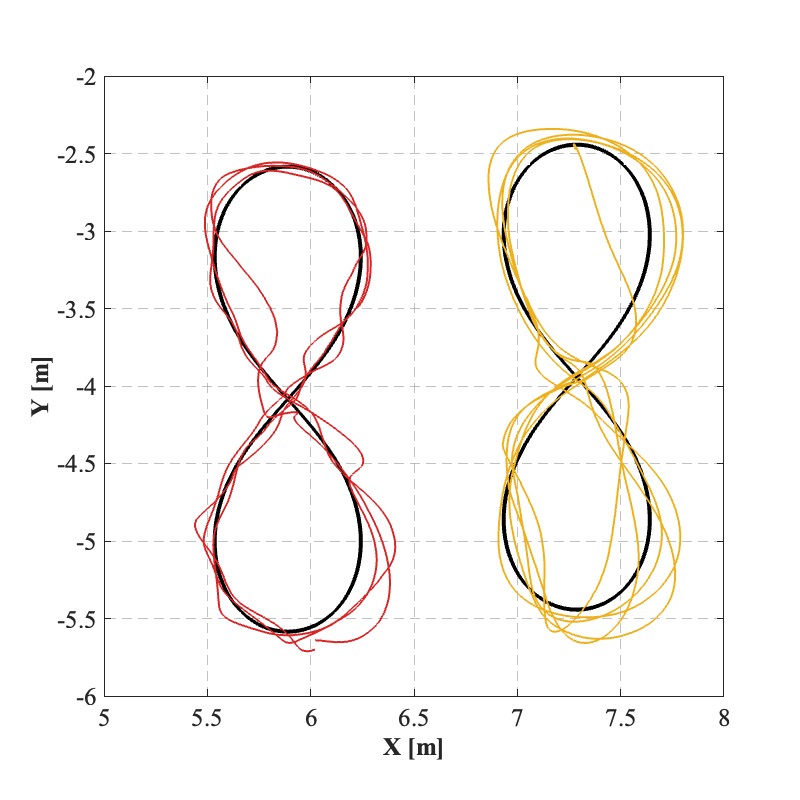
Baseline 1 (No Intentional Disturbance)

Front View

Rear View
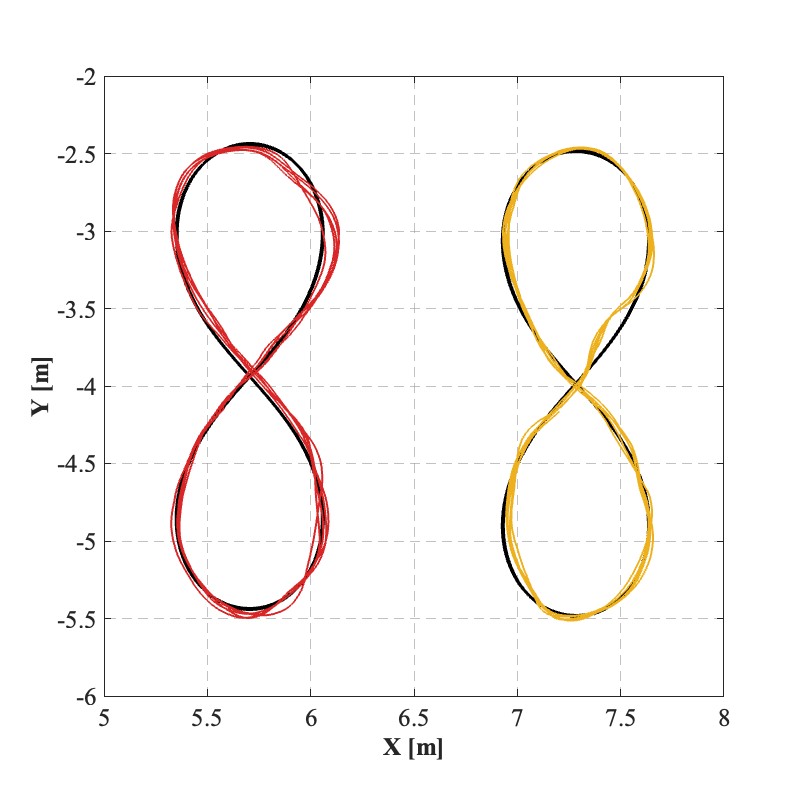
Baseline 1 Results

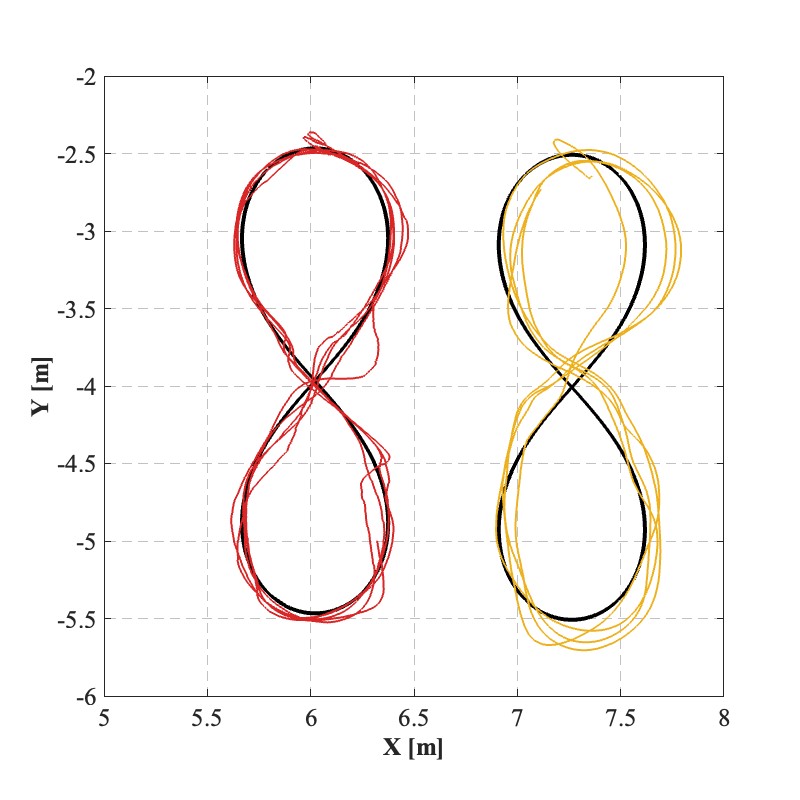
Baseline 2 (Offline + LMPC)

Front View

Rear View

Baseline 2 Results

Baseline 3 (Online + RTMPC)

Front View

Rear View

Baseline 3 Results

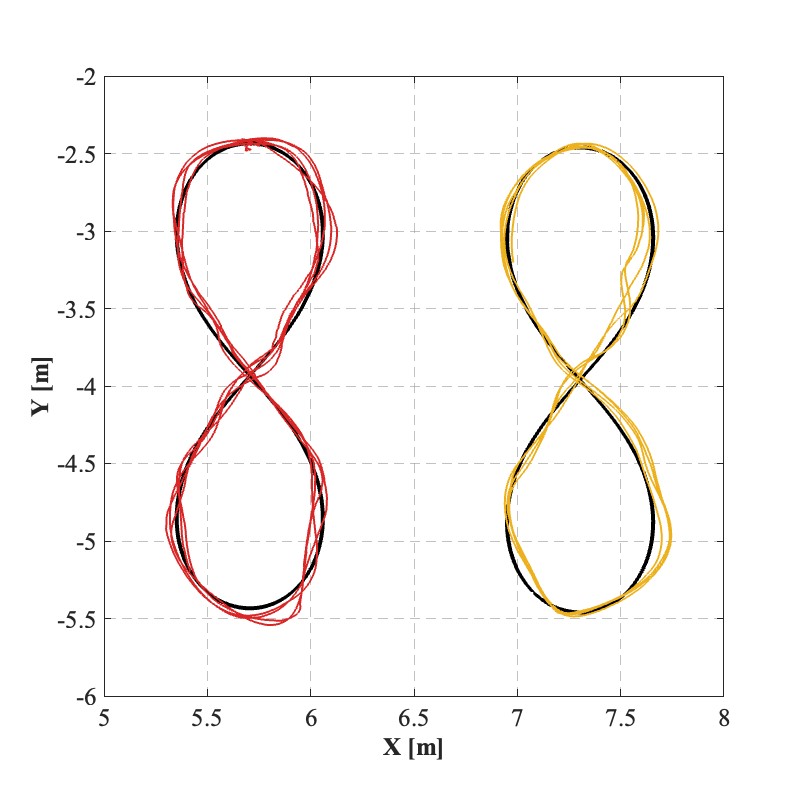
Proposed (Offline + Online + RTMPC)

Front View

Rear View

Baseline 4 Results

Methodology

Proposed Left Result

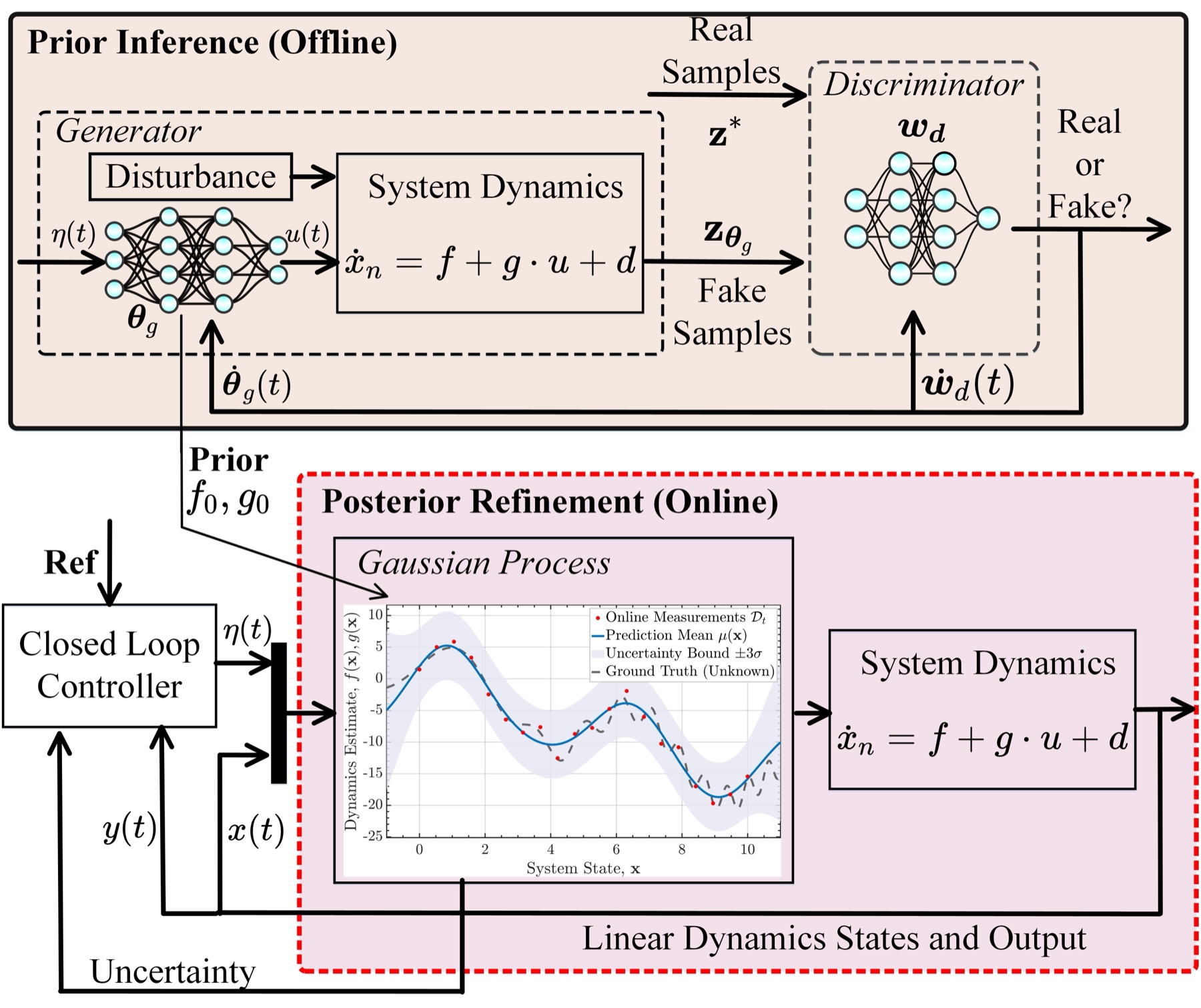
The offline phase utilizes GANs to extract structural priors f0, g0, initializing the linearization control law. Subsequently, the online Bayesian GP incorporates these priors as the baseline mean, iteratively refining the dynamics estimate against real-time data to ensure the system converges to the linear form. Ultimately, the closed-loop controller operates on these linearized dynamics to execute precise trajectory tracking, explicitly leveraging the predictive uncertainty quantified by the online Bayesian update.
Proposed Right Result

The offline phase establishes structural priors f0, g0 via adversarial gradient dynamics. During deployment, the online Bayesian phase continuously fuses these priors with real-time data to update posterior estimates, which subsequently drive the robust feedback linearization and adaptive gain scheduling.

Hardware and Experimental Setup

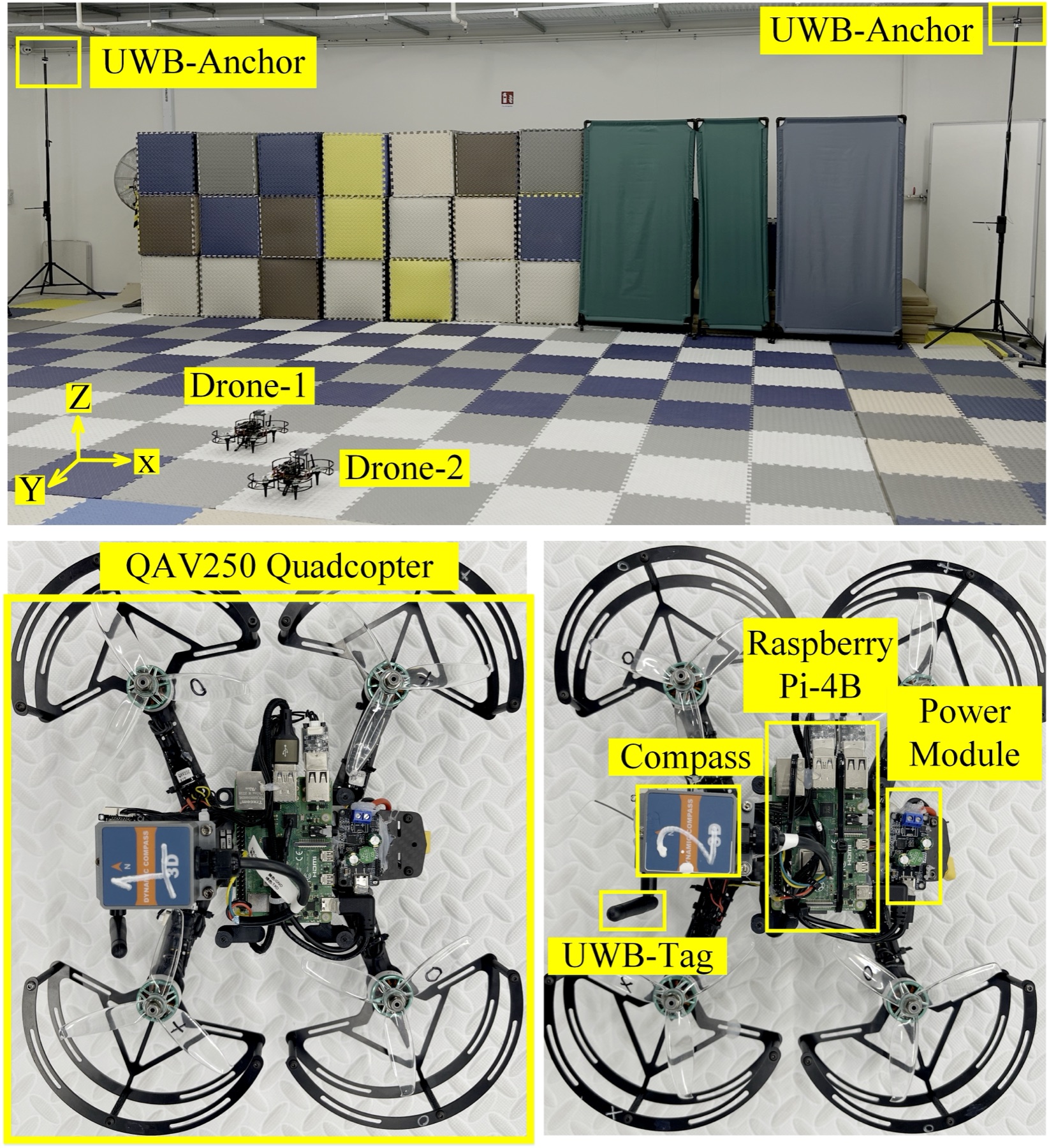
Hardware Architecture and UWB Positioning Setup

UWB Positioning System Setup

  • Ground Station Architecture: The experimental area is surrounded by six fixed UWB anchors to establish a global coordinate reference.
  • Onboard Receiver: Each UAV is equipped with a bottom-mounted UWB tag to acquire real-time position signals and transmit them to the onboard processor.
  • Coordinate Alignment: An external compass ensures precise alignment between the UWB reference frame and the flight controller's internal coordinate system.
  • Altitude Measurement: Due to the inherent inaccuracy of UWB in the vertical (Z-axis) direction, a Time-of-Flight (ToF) sensor is utilized for precise altitude estimation.

UAV Platform & Physical Specifications

  • Airframe Architecture: Built on a classic QAV250 quadrotor frame, equipped with high-performance TMOTOR VELOX V3 (KV1950) motors.
  • Weight Distribution: The single-UAV Maximum Takeoff Weight (MTOW) is 0.9 kg, carrying an experimental payload of 224 g.
  • Dynamic Characteristics: The combined lateral aerodynamic drag generated by industrial fans and the transient tension spikes from payload swinging account for approximately 20%–25% of the vehicle's nominal hovering thrust.

Onboard Computing Unit

  • Core Processor: A Raspberry Pi 4B (8GB) serves as the onboard computer, executing the high-level online learning algorithms and real-time closed-loop control for outer-loop position and velocity.
  • Flight Controller: A Pixhawk 6 mini autopilot running PX4 firmware handles high-frequency attitude estimation, inner-loop attitude control, and motor driving.
  • Data Flow Integration: The onboard computer achieves centimeter-level positioning resolution by fusing UWB positional data with IMU inertial measurements via an EKF2 filter.